Shrawardine appears in Domesday Book as Saleurdine. Its short entry records a landholding, the people working it, plough teams and a valuation. It gives evidence of the settlement before the later history of Shrawardine Castle, without describing how the village looked. Eyton, pp. 94–95 ↗; Wright, p. 35 ↗.
Shrawardine in the 1086 survey
William the Conqueror ordered the Domesday survey at Christmas 1085; it was undertaken in 1086. It investigated landed property and its value, comparing contemporary holdings with those of King Edward the Confessor's time. It was not a census of everyone living in England. The National Archives ↗.
Wright's edition places Shrawardine in Baschurch hundred and names Rainald as its holder, with Æli holding it in King Edward's time. Historic England identifies the Domesday landholder as Sheriff Rainald de Bailleul. Wright ↗; Eyton ↗; Historic England ↗.
What the entry records
The figures below follow Wright's translation, checked against the Latin entry transcribed by Eyton. Wright, p. 35 ↗; Eyton, pp. 94–95 ↗.
| Item | Recorded detail |
|---|---|
| Land assessment | Two hides |
| Plough teams in demesne | Two |
| Other plough teams | Two and a half, with the villagers and smallholders |
| Workers and tenants | Four bovarii, three villani and four bordarii |
| Valuation | Forty shillings, both previously and at the survey |
Wright translates bovarii as “neatherds”, an older term for cattle herdsmen. Villani and bordarii are commonly rendered as villagers and smallholders: these are categories of peasant holding, rather than a list of everybody in the settlement. Wright ↗; Domesday glossary ↗; The National Archives ↗.
Understanding the figures
A hide was a unit used in land assessment; its acreage varied. The two hides should not be read as an exact measurement of the modern village. Demesne refers here to land farmed directly for the lord, distinguished from the peasants' holdings. Domesday glossary ↗.
Open Domesday summarises Shrawardine as 11 households. This is not a population of 11 people, and the entry does not supply a complete headcount from which to describe the village's population with certainty. Open Domesday's county listing ↗; The National Archives ↗.
What Domesday does not tell us
Jones's archaeological account states that Domesday mentions no fortification at Shrawardine. A conflicting statement in Sandra Morris's thesis attributes the building of a motte and bailey by Rainald to Domesday. That claim is not supported by the entry as reproduced by Wright and Eyton. Domesday should therefore not be used to give the castle a foundation date or a named builder. Jones, p. 15 ↗; Morris, p. 37 ↗; Wright ↗; Eyton ↗.
The meaning of the place-name is also unsettled. Historic England reports a suggested derivation connected with the sheriff; Jones discusses alternatives involving a personal name or a hollow. Saleurdine is a recorded spelling, not proof of any one explanation. Historic England ↗; Jones, p. 15 ↗.
For the later evidence, continue to Shrawardine Castle or browse the history section.
Sources & further reading
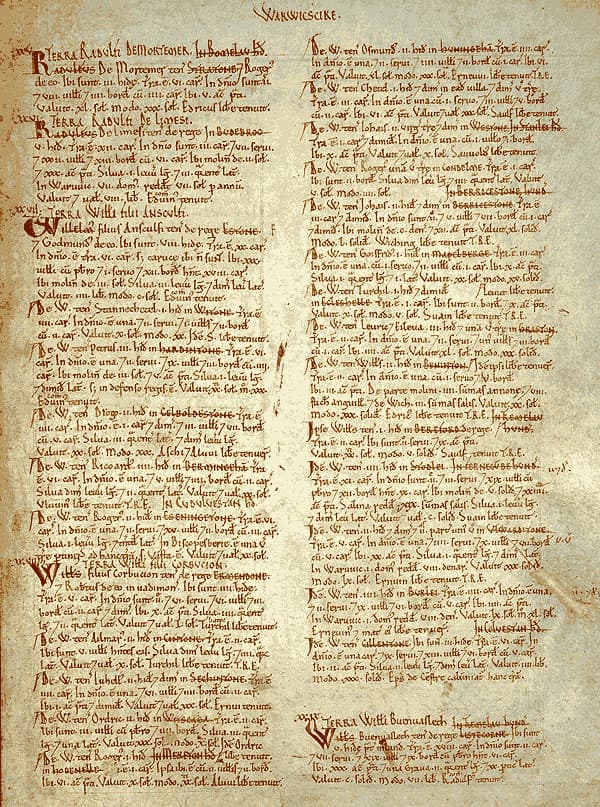
- Image: Domesday Book, Warwickshire manuscript page. Creator unidentified; 11th century. Wikimedia Commons, sourced from The National Archives; marked public domain. Accessed 18 September 2026. ↗
- Thomas Wright, Domesday Book for Shropshire: the original text edited and translated into English (1865), p. 35. Digitised by Columbia University Libraries. Accessed 18 September 2026. ↗
- R. W. Eyton, Antiquities of Shropshire, vol. X (1860), pp. 94–95: Latin entry and reference to Domesday folio 255a, column 1. Online transcription. Accessed 18 September 2026. ↗
- The National Archives, Domesday Book: research guide. Accessed 18 September 2026. ↗
- N. W. Jones, Archaeological Surveys at Shrawardine Castle, Transactions of the Shropshire Archaeological and Historical Society, vol. 77 (2002; issued 2004), pp. 15–25. Accessed 18 September 2026. ↗
- Historic England, Shrawardine castle and settlement remains, NHLE 1015707. Accessed 18 September 2026. ↗
- Open Domesday, Shropshire: county listing, using data created by Professor J. J. N. Palmer and his team at the University of Hull. Accessed 18 September 2026. ↗
- The Domesday Book Online, Glossary: hides, lordship, villagers and smallholders. Accessed 18 September 2026. ↗
- Sandra Morris, Shropshire Deer Parks c.1500–c.1914, PhD thesis, University of East Anglia (2015), p. 37. Consulted for the conflicting claim about the castle. Accessed 18 September 2026. ↗