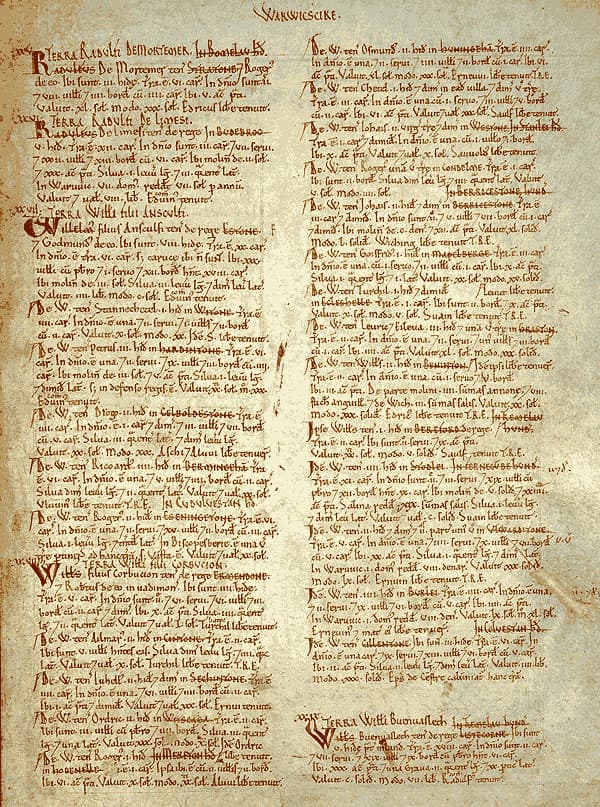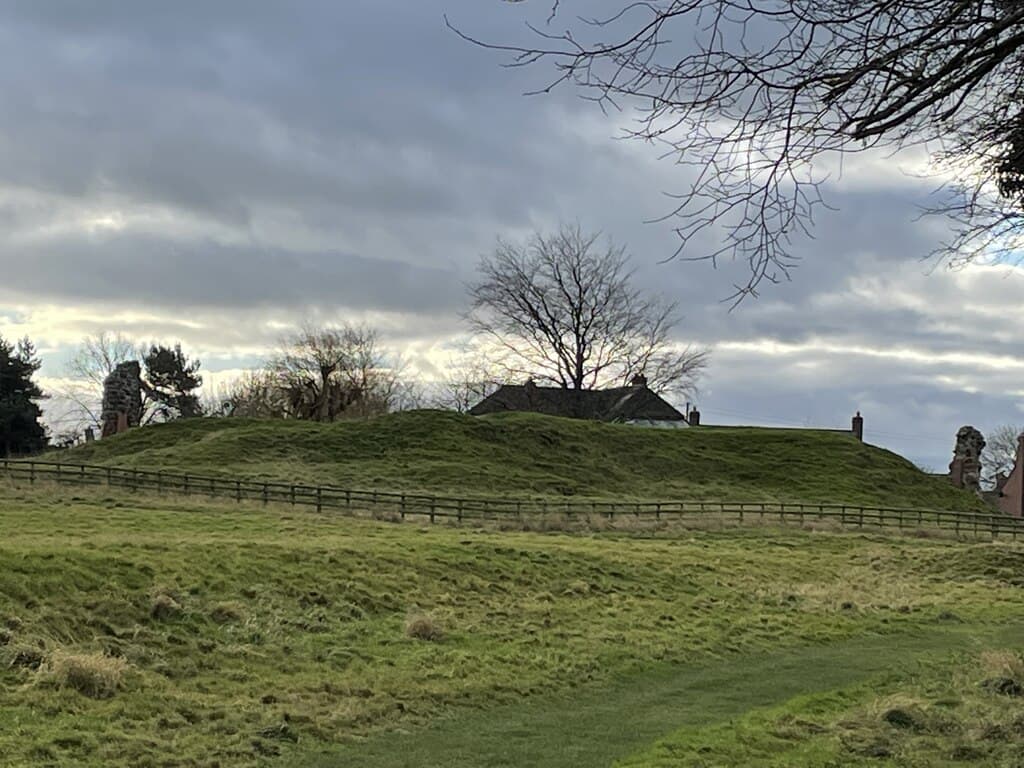
The Civil War brought a Royalist garrison to Shrawardine Castle, followed by a siege and destruction in 1645. The story concerns the village as well as the fortress: accounts describe damage to the church, homes and other buildings. The evidence discussed here centres on 1644–45 within the wider period of the Civil Wars.1 ↗
A Royalist garrison
An account from the Shrawardine parish register, transcribed in Frances Stackhouse Acton’s The Garrisons of Shropshire (1867), dates the establishment of the King’s garrison to 28 September 1644. It names Sir William Vaughan as governor and describes the castle as his headquarters.2 ↗
There is a difference in the published chronology: the Cromwell Association’s gazetteer places Vaughan’s garrisoning of the castle in spring 1644. The September date used here is specifically the date given in the register transcription; the two accounts have not been reconciled.3 ↗
Destruction of the church and village
The register account says that the church was pulled down on 8 June 1645, and that burning in the village took place on Midsummer eve and Midsummer day. It also describes the loss of the parsonage and castle outbuildings. These are details preserved in a later published transcription, rather than observations from an original manuscript examined for this page.2 ↗
The sequence is less straightforward than a single episode of destruction. Archaeologist N. W. Jones describes the chancel being pulled down after the fall of Shrewsbury in February 1645, to prevent its use by Parliamentarian snipers, with further demolition of the church in June. Historic England’s scheduling account instead summarises church and village clearance as taking place during the siege to improve the castle’s defences.4 ↗ 1 ↗
The wartime damage belongs to the history of St Mary’s Church as well as that of the castle.
The siege of June 1645
Historic England and the transcribed register describe a five-day siege before the garrison surrendered to Parliamentarian forces. Jones dates the surrender to 29 June 1645.1 ↗ 2 ↗ 4 ↗
The Cromwell Association’s gazetteer agrees on the surrender date but describes a long siege, without specifying its duration. That difference remains unresolved; the five-day account above is attributed to its sources. No detailed bombardment, gun positions or casualty figures are reconstructed here.3 ↗
Burning and dismantling the castle
Jones reports that the castle was apparently burned within two weeks of its fall and subsequently quarried for building stone, initially for repairs to Shrewsbury Castle. Historic England describes Parliamentarian troops dismantling parts of the castle, taking materials to Shrewsbury and burning the timber before leaving.4 ↗ 1 ↗
The official records disagree over the year. Historic England’s separate listed-building entry says the castle was slighted — deliberately damaged — in 1644. Its scheduled-monument account places the siege and subsequent destruction in 1645. This page follows the latter chronology, also supported by Jones, while retaining the discrepancy rather than assuming an explanation.5 ↗ 1 ↗ 4 ↗
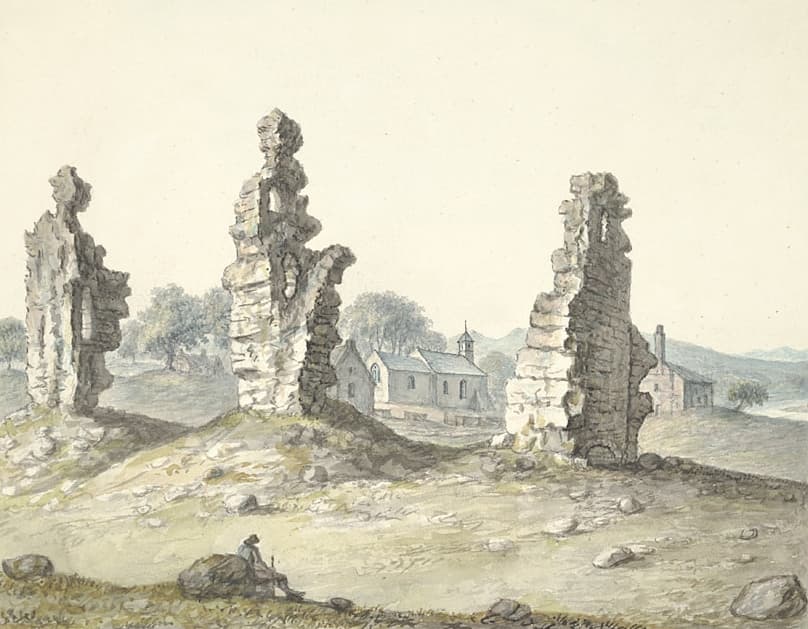 John Ingleby, Sh(r)awardine, 1796. National Library of Wales, PD9243. Public domain.
Ingleby’s watercolour is a much later view of the ruins, not a depiction of the siege. View the collection information and public-domain record on Wikimedia Commons ↗.
What the surviving evidence can tell us
Not every earthwork can securely be connected with the war. Historic England offers two possible explanations for the abandoned house platforms west of the castle: earlier medieval difficulties following flooding, or clearance during the Civil War.1 ↗
Jones reproduces a 1728 estate map showing castle ruins and neighbouring buildings. It helps explain the later landscape, but is not a wartime plan. The map can be consulted in his paper, figure 2; it is not reproduced here because reuse permission for that image has not been established.4 ↗
For other local subjects, see the History section.
Sources and further reading
- Historic England, Shrawardine castle and settlement remains, National Heritage List for England entry 1015707 ↗. Scheduling amended 4 March 1997.
- Frances Stackhouse Acton, The Garrisons of Shropshire during the Civil War, 1642–1648 ↗ (Shrewsbury: Leake and Evans, 1867), p. 72. Published transcription of the Shrawardine register; relevant text consulted through indexed extracts of the digitised volume.
- Cromwell Association, Gazetteer, Shropshire: Shrawardine Castle ↗. The indexed entry supplies the alternative spring 1644 date.
- N. W. Jones, “Archaeological Surveys at Shrawardine Castle” ↗, Transactions of the Shropshire Archaeological and Historical Society, vol. 77 (2002; issued 2004), pp. 15–25. Historical account on pp. 15–16; estate map on p. 17, figure 2.
- Historic England, Remains of Shrawardine Castle, National Heritage List for England entry 1366944 ↗. Contains the conflicting 1644 slighting date.
Sources checked on 18 September 2026. The register has been consulted through its published transcription, not the original manuscript. Some later accounts draw on the same earlier material and are not independent witnesses.
Photograph credit: Shrawardine Castle, Andrew Shannon, 15 December 2021 ↗, © Andrew Shannon, licensed under Creative Commons Attribution-ShareAlike 2.0 ↗. The existing photograph is reused without editing; the site resizes it for display.
Watercolour credit: John Ingleby, Sh(r)awardine, 1796, National Library of Wales, PD9243; source and public-domain declaration ↗. The existing image is reused without editing.